18 September, 2026
No. All natures have equal probability for all Pokémon.

Have you ever wondered why two identical Pokémon perform differently in battle? The secret of this often lies in their nature.
Natures are a core mechanic of Pokémon, and it determines how its attributes grow. But most trainers, at the beginner level, do not have an understanding of this.
That’s when the Pokémon nature chart comes into the picture. It is one of the most important tools for understanding the modification of Pokémon stats. Mind you, all this happens behind the scenes, but as trainers, you must know about it.
The subtle mechanic could influence the outcome of most battles, especially when comparing builds across Pokémon like Bulbasaur or Charizard. Understanding the Pokémon nature chart could take you from a competitive player to a competitive master.
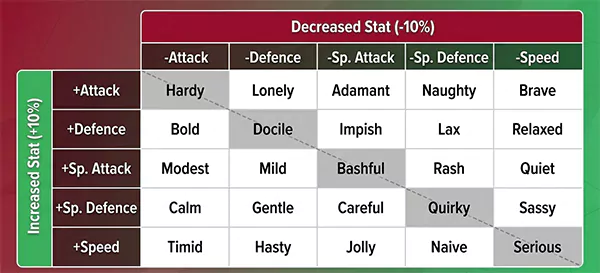
The Pokémon nature chart might look difficult to read at first, but it is simpler once you understand the trade-off.
According to some authoritative resources like Bulbapedia and Pokémon Planet, the nature chart is essentially a grid system that shows the relationship between a Pokémon’s personality and its growth.
Here is how nature affects Pokémon stats.
The stats affected by the natures are: Attack, Defense, Special Attack, Special Defense, and Speed. These stat differences become more noticeable when you explore the full roster in guides like how many Pokémon are there.
Here is the Pokémon Nature chart you should take a look at.
| Nature +/- | -Attack | -Defense | -Sp. Attack | -Sp. Defense | -Speed |
| +attack | Hardy | Lonely | Adamant | Naughty | Brave |
| +Defense | Bold | Docile | Impish | Lax | Relaxed |
| +Sp. Attack | Modest | Mild | Bashful | Rash | Quiet |
| +Sp. Defense | Calm | Gentle | Careful | Quirky | Sassy |
| +Speed | Timid | Hasty | Jolly | Naive | Serious |
The + stat will increase 10%, and the corresponding – stat will decrease by 10% for a particular nature.
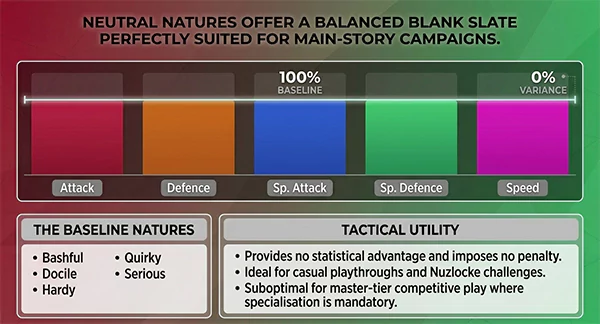
Every nature does not change stats. Some of them are completely neutral.
It means they increase and decrease the same stat, which results in no change in the stat.
Players often overlook these natures; however, they can come in handy in certain situations, especially when training Pokémon like Dratini.
A bashful-natured Pokémon increases and decreases the Special Attack stat. So, ultimately, it cancels itself out.
Despite that, the bashful nature Pokémon can still be utilized for casual playthroughs, Nuzlocke challenges, and even when evolving Pokémon such as what level does Skwovet evolve.
It might not be great for competitive play, but it also won’t hinder your progress.
A docile-natured Pokémon is another neutral nature that increases and decreases the defense stat. Essentially, it is a blank slate.
It may not be optimal for competitive play, but it still works well for story progression and exploring Pokémon like Koffing.
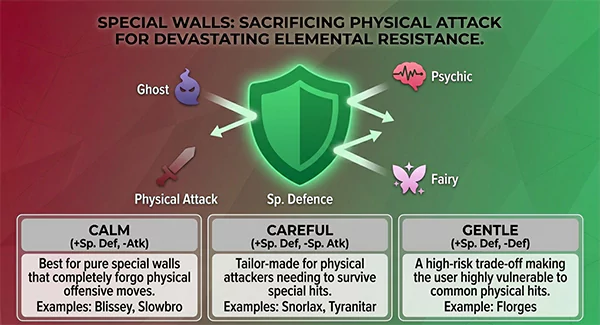
There are four natures that prioritize growth in special defense: Calm, Gentle, Sassy, and Careful.
A special defensive nature is essential for withstanding powerful hits from attackers who possess Ghost, Psychic, and Fairy-type moves.
By boosting this stat, you can transform your Pokémon into a resilient tank or defensive wall.
A calm nature Pokémon is best for defensive builds and long battles, similar to how players analyze value and rarity in guides like most expensive Pokémon card. In that case, it can only be used for defensive purposes.
A calm nature Pokémon is best for:
In competitive strategy, choosing a Pokémon nature calm build ensures that the Pokémon lasts for a long time against special attackers.
A careful nature Pokémon increases special defense and decreases special attack. This nature is tailor-made for special tanks and physical attackers such as Tyranitar and Snorlax.
The stat that it decreases is often an unused special attack. It means it maximizes the defence with minimal offensive drawback.
Careful nature Pokémon are ideal for:
This specialization allows these Pokémon to survive the offensive capabilities of Ghost and Fairy types. It allows them to take hits and also deal damage with devastating physical strikes.
A gentle nature Pokémon can boost special defense while sacrificing physical defense. So, it is a high-risk, high-reward choice.
The risk-reward scenario:
In competitive play, it is a very rare trade-off as physical hits are most common.
However, a nature gentle Pokémon like Blissey or Florges can work if they have very low physical defense.
The sassy nature Pokémon is great for Trick Room strategies because it boosts special defense and lowers speed.
In the Trick Rooms, slower Pokémon move first, and that becomes an advantage.
With sassy nature Pokémon, the trainers can create a specially defensive tank. It can outspeed opponents under unique conditions.
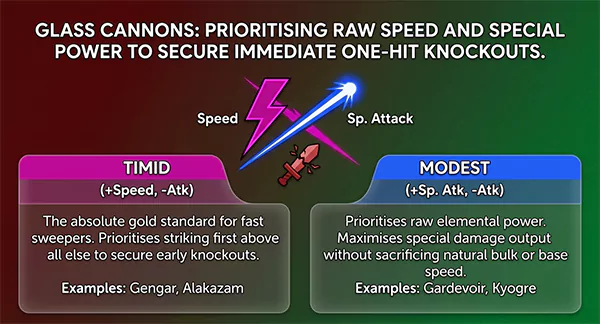
Speed determines which Pokémon attacks first, and that often decides the outcome of the attack. On the other hand, a special attack amplifies the damage of elemental moves.
This makes these nature Pokémon important for powerful and fast-paced offensive sweepers.
A timid nature Pokémon is the gold standard for fast and special sweepers like Gengar and Alakazam.
This nature boosts speed and sacrifices physical attack. It ensures that these “glass cannons” strike first to secure a one-hit knockout. It is best for:
In competitive play, timid nature Pokémon are one of the most important ones for outspeeding opponents.
The quiet nature Pokémon is great for heavy-hitting special attackers that don’t rely on agility. It boosts special attack and lowers speed, which maximizes raw power that is already much slower.
Just like the sassy nature, quiet nature Pokémon also thrive in the Trick Room as well. It allows sluggish powerhouses like Hatterene or Vikavolt to strike first with a powerful force. They are best for:
In a doubles team format, the nature quiet Pokémon strategy is great for dominating the field.
If you pair a slow, serious damage attracker with a Trick Room setter, you could easily turn a speed disadvantage into a tactical win. Because:
If you are a trainer who prioritizes raw power, a modest nature Pokémon should be a great choice. This nature boosts special attack and lowers irrelevant physical attack stats.
Basically, it maximizes damage output without sacrificing bulk or speed. This is the most common nature for Special Attackers like Gardevoir or Kyogre. It is best for:
This nature perfectly optimizes your team’s offensive potential.
Related Read: How Many Pokémon Are There? Total Number, Generations & Full Guide
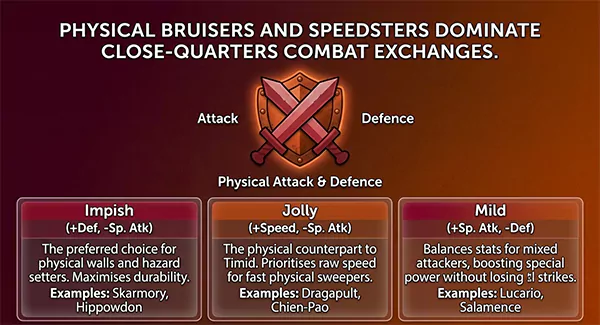
Most physical moves in the Pokémon world rely on the Attack stat to inflict maximum damage. Natures like Impish or Brave are tailored for offensive and defensive physical builds.
The brave-natured Pokémon is a tactical play powerhouse that boosts attack and lowers speed. So, it is perfect for Pokémon that use the Gyro Ball move, which deals more damage to slower users.
It is best for:
Moreover, it is highly valued on Trick Room teams where slow and bulky physical attackers like Conkeldurr or Copperajah have an advantage.
The impish-natured Pokémon is the preferred choice for a physical wall. Because it boosts defense and lowers the not-so-important special attack stat.
This nature maximizes durability without sacrificing damage from moves like Earthquake or Brave Bird. It is best for:
Skarmory and Hippowdon need to ensure repeated physical blows while supporting their team.
The jolly-natured Pokémon serve as the physical counterpart to the timid nature. It prioritizes raw speed over unused special attack attributes.
If you have Dragapult or Chien-Pao, then this nature should be your choice for these Pokémon. It is used by:
By using jolly nature Pokémon, trainers ensure that their high-impact attackers surpass the competition.
The mild-natured Pokémon is for those who prefer mixed attackers that boost special attack without sacrificing physical power.
This nature lowers physical defense instead of a core offensive stat. So, a mild-natured Pokémon like Lucario or Salamence can effectively pressure opponents with their powers.
This nature is best suited for:
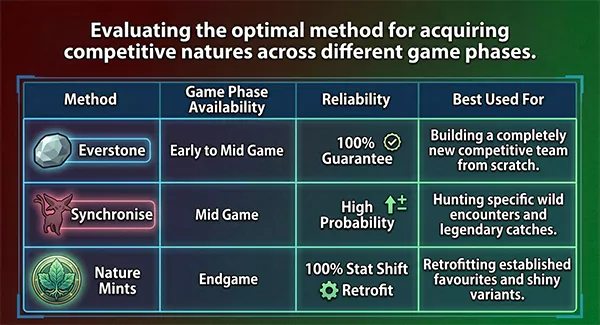
It is essential for trainers to optimize their team, and modern games offer a few ways for you to get the right nature.
Here is how.
To breed for the perfect competitive edge, give a parent an Everstone to pass down their exact nature to their offspring. This method works 100% of the time and guarantees you will get the required nature.
If you already have a favorite and want to change its nature, use Nature Mints. Nature Mints were introduced in Sword & Shield and are a game-changer for trainers. It allows trainers to change the stat effect of a Pokémon without altering its original personality.
If you use a Pokémon with a synchronize ability (like Alakazam or Espeon) at the front of a party in the wild, the odds increase significantly that the wild encounters will share the same nature.
Related Read: Charizard: Mega Charizard X & Y Evolution, Types, Stats & Guide
Mastering the Pokémon nature chart is one of the best ways to improve your team’s competitive viability.
Grinding for IVs and EVs can be a time-consuming process, but choosing the right nature for a Pokémon gives you an immediate, significant power boost.
If you master this system, you will be transformed from a casual trainer to a strategic powerhouse.
What do you think about the Pokémon nature chart? Do let us know in the comments.
No. All natures have equal probability for all Pokémon.
We can say that natures are more important as they provide an immediate 10% stat shift.
There is no best nature because the choice depends entirely on the Pokémon’s specific role.
No. Nature either boosts one stat and lowers one stat or balances out a stat.
Source:
Address: 3801 Capital Of Texas Hwy N, Austin, TX 78746
Email at: info.weburic1@gmail.com
Call Us: +19707840507